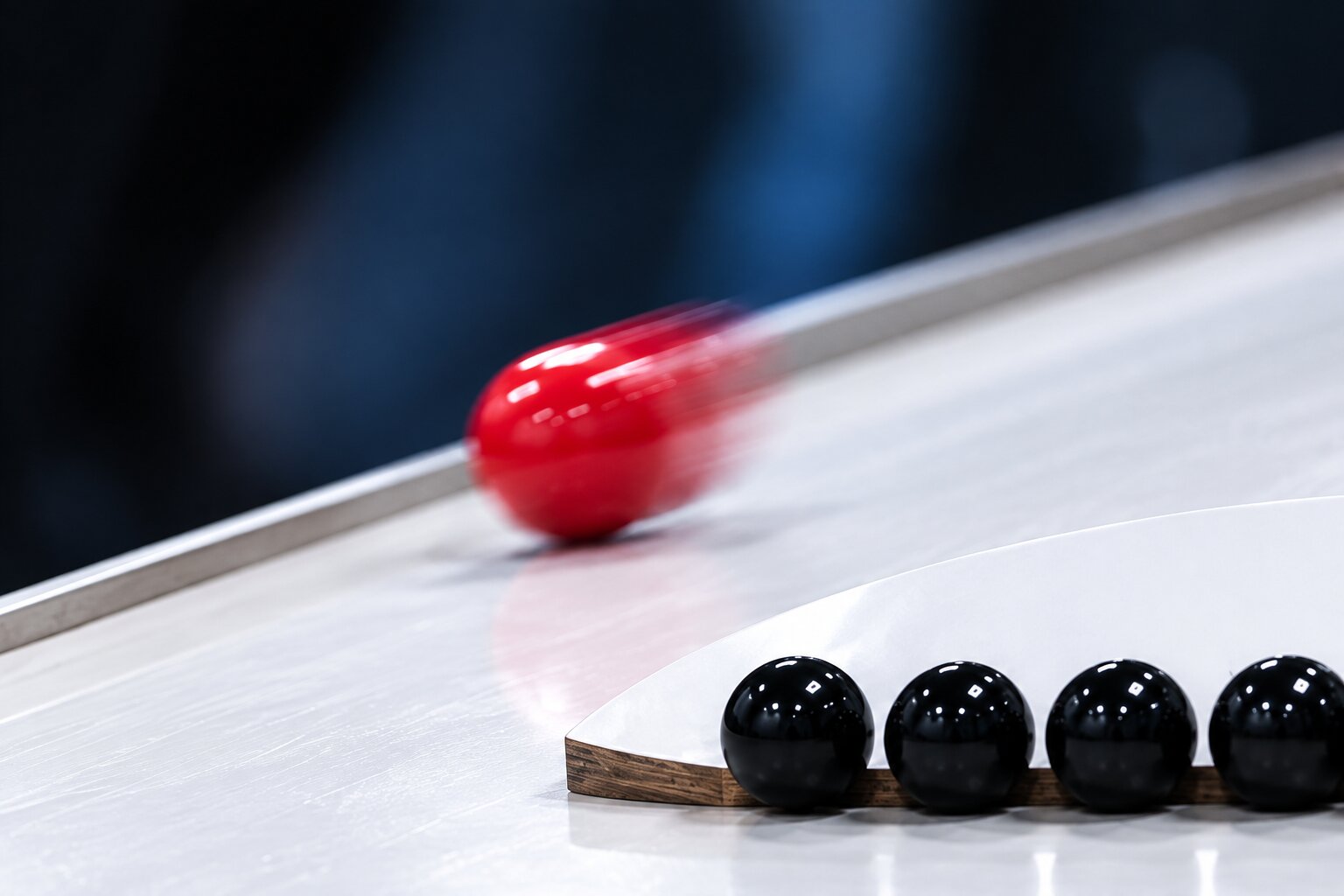

THE GAME EXPLAINED / STAR CLUSTER BALL
Star Cluster Ball Table Explained: Zones, Plates & Setup
Learn to identify the playing surface, launch area, three scoring plates and side rails, plus the equipment details that vary between events.
QUICK RULES
Table and target plates
Position counts come from a public rules overview; a verified universal table specification is not available.
- Release end
- Players send a ball from the permitted area toward the target plates. Visible
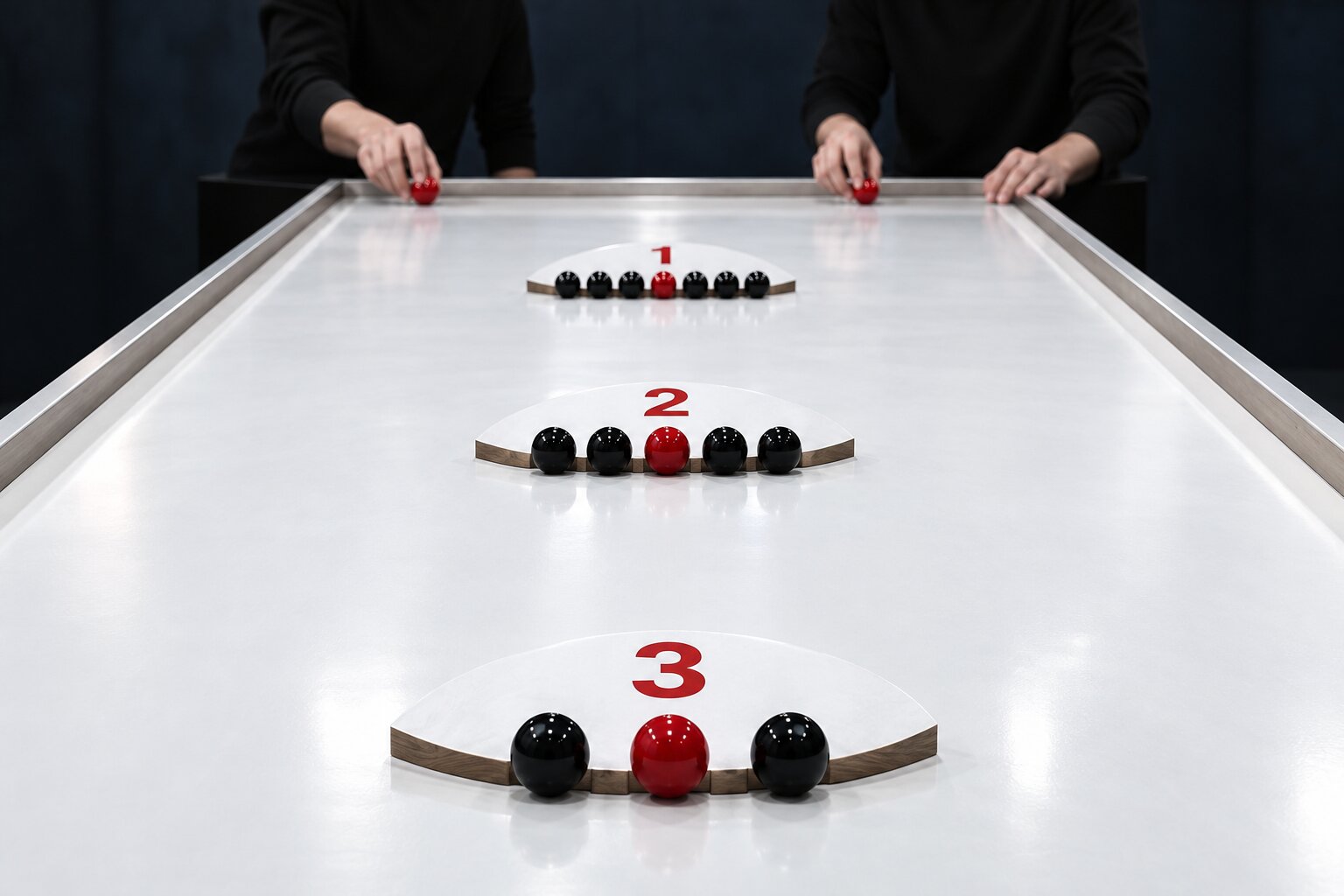
- Plate 1
- 7 positions; 1 point per ball in one published base-scoring version. Version example
- Plate 2
- 5 positions; 2 points per ball in that version. Version example
- Plate 3
- 3 positions; 5 points per ball in that version. Version example
- Dimensions
- Confirm length, width, slope and ball size against the actual equipment model. Unverified
01 / THE GAME EXPLAINED
Read the table before reading a score
A Star Cluster Ball table brings release, movement and resting position into one visible space. A common first mistake is to stare at the numbers around a target plate without knowing where the ball began or what route it took. Read the table in order: locate the release area and body boundary, look across the surface and side rails, then identify the three plates and the balls already settled near them. That gives you a map of the contest rather than a collection of disconnected scoring marks.
Footage and public explainers show a common arrangement, but they do not replace the equipment specification for an event you are entering. Tables can differ in size, surface, slope, plate labels or balls. Any difference that could affect a valid shot should be explained by the host before play. This guide describes how parts of the table work together and what to check on site. Without a governing specification, it does not present one table’s dimensions as a worldwide standard.
02 / THE GAME EXPLAINED
Release area and play line
The release area is where a ball begins its journey. Public descriptions refer to a play or foul line and commonly require a release from a designated zone. For a participant, the important questions go beyond where a line is drawn. May the body cross it? Where must the ball first touch the playing surface? Does the event permit a roll, push or flick? A video angle showing a player send a ball forward is not enough to decide whether the same movement would be legal in your local event.
Ask an umpire or host to demonstrate a full release, including stance, hand position and the moment the ball leaves the player. Starting from a consistent point during practice makes direction and pace comparable. If the line is worn, hidden or ambiguous, ask someone to clarify it before the first contested ball. Waiting for a disputed shot and then arguing from memory is worse for both players.
03 / THE GAME EXPLAINED
The surface and the route
The continuous surface determines how a small ball rolls. Public descriptions usually present the table as sloped. Slope, material, evenness and cleanliness can all affect pace and final position. A beginner does not need to estimate a precise angle. Watch when the ball begins to slow and how much movement remains as it approaches a plate. The same gesture that stops neatly on one table may fall short or carry too far on another.
Keep observed effects separate from verified specifications. You can compare how a particular surface changes your touch; you cannot declare that every table must use a certain board material or angle without a maker’s document. If the surface has debris, moisture, visible damage or unexpectedly erratic movement, stop and have the host inspect it. A consistent surface helps both players compete under comparable conditions.
04 / THE GAME EXPLAINED
Rails and the edge of play
Raised rails make the active area easier to see and may alter a ball’s route. A ball that touches a rail and returns is not necessarily in the same state as one that leaves the playing area. An event may also define gutters, returned balls or non-scoring balls in its own rules. A still image cannot settle those questions. When watching a shot, first ask whether the ball remains on the playable surface, then whether it occupies a target position, and finally how the umpire or scoring system treats the result.
Be patient near a boundary. A ball may still be moving after apparent contact with an edge. Picking it up or declaring it out too early can interfere with the decision. During practice, repeated contact with a rail is useful feedback about line and pace. Loose framing, sharp parts or a ball trapped in an uncertain place should be handled by the host. Equipment safety and consistent calls matter more than any fortunate rebound.
05 / THE GAME EXPLAINED
Three plates and the reported position layout
The overview supplied for this project describes a familiar arrangement of three semicircular target plates: seven positions on the first, five on the second and three on the third. “Seven, five, three” is initially a statement about visible structure. It does not automatically define the point value of each plate or a bonus for adjacent balls. First identify which positions are open, which are occupied by each colour and whether the entrance remains accessible. Only then apply the scoring format used in the match.
More available positions do not always mean an easier shot; distance, entry route and settled balls matter. Fewer positions do not always justify greater risk, particularly while a player is still learning pace control. A push may aim to claim an open place or to change an existing arrangement. For a newcomer, accurately saying “a red ball sits near plate two and a black ball blocks the entrance” is more useful than reciting an unsupported ranking of targets.
06 / THE GAME EXPLAINED
Two colours and two developing positions
Match images often show red and black balls. Their essential job is to make opposing positions distinguishable. Whether an individual event fixes those exact colours is an equipment question for the host. Try following just one colour at first. How many of its balls occupy each plate? Which are on the open surface? Where does the other colour obstruct an apparent route? Adding the second colour to that picture reveals how the sides compete for the same limited space.
Lighting and reflections can make ball colours difficult to distinguish in a photograph. A formal record should not rely only on a poor screenshot. If balls are damaged or their markings are unclear, settle ownership before a match. A guide can explain why contrasting colours matter, but the number, material, weight and special marks of balls belong to an equipment specification and an event format.
07 / THE GAME EXPLAINED
What changes after a ball settles
A settled ball has more possible effects than simply “in” or “out.” It may occupy a plate position, stop before an entrance, become an obstacle on the open surface, displace another ball or alter a future route. Review a shot in sequence: locate the new ball, check whether an older ball moved, then identify any newly open or blocked position. This process gives you a clearer picture of the next decision than watching a score change alone.
Actual scoring may depend on whether a ball has fully stopped, how a boundary position is treated or who receives points after a collision. Formats may disagree, so this guide does not referee a scene from a description alone. In practice, do not reach for a ball while it is moving. Describe the resulting layout first, then apply the organizer’s rule to decide what happens next.
08 / THE GAME EXPLAINED
A practical pre-session equipment check
A host can begin by checking table stability, a clean surface, secure rails and plates, and complete balls whose colours are easy to tell apart. Mark the release area, prepare the chosen rules card, and decide who keeps time, records points and resolves disputes. Both players should see the same boundaries and targets. If electronic scoring is used, run a sample entry before the match begins so the display and the human explanation agree.
This check keeps disagreements before the opening shot rather than making a social game bureaucratic. Many beginner difficulties come from not knowing how this particular table will be judged. A short card can cover legal release, target positions, base and bonus points, non-scoring balls, fouls, time and victory condition. In an introductory session, show each rule on the physical equipment and explain it in one clear sentence.
09 / THE GAME EXPLAINED
Why specifications and buying advice need care
A measurement, material or price found online may describe one maker, product generation or event setup rather than a universal standard. For orientation, understand that a stable table must suit its targets and ball set. For purchasing or organizing a competition, request dimensions, installation instructions, maintenance requirements and safety information from the supplier. Then confirm that the chosen equipment is accepted by the event format. Tables that look alike in images can produce different ball speed and resting positions.
For home or community sessions, available space, transport, storage and repairability also matter. Do not treat an introductory article as a purchasing specification or repeat an unverified number as an official measurement. If you own a table, record its maker, model, plate layout and compatible balls. That context helps when comparing your practice with a video filmed using different equipment.
10 / THE GAME EXPLAINED
What to read next
Once you can point out the release area, surface, rails, three plates and opposing colours, you have the foundation for following a match. Watch one complete shot: where does the ball begin, how does it pass settled balls, and where does it end? Then read the turns and scoring guide to connect visible positions with your event’s rules. If you want to play, practice a controlled release with a host rather than attempting elaborate rail shots before learning the legal area and safety requirements.
The same structure produces a different puzzle after every push. The table has not changed, but the available lanes have: some positions are now occupied, others open, and a once-safe route may be crowded. Treating equipment as a changing map helps explain why a player sometimes chooses a nearby position and sometimes accepts a harder attempt. It also shows which questions must be answered by the actual competition rules rather than by a photograph.
11 / THE GAME EXPLAINED
Common questions about the table
Do plate numbers equal points for every ball? Not necessarily. Plate labels, position counts and base scores are separate concepts; check any published scoring example against the local format. Should a ball resting outside a plate be removed immediately? Some variants may leave it in play; others define a particular state. Wait until it has stopped and follow the local call. Can you substitute a similarly sized ball? Different mass, diameter or material changes rolling and contact. Use approved equipment in formal play.
What exact slope should the table have? Without a verified specification, an online number is not a standard. Participants should know that the equipment has been accepted for the event; organizers and buyers need the supplier’s actual measurements. Is rail contact a foul? Rails are part of the table, but the treatment of a particular action depends on the rules being played. When equipment and an explanation disagree, stop and clarify before an uncertain boundary becomes a contested result.
SOURCES & MORE
Independent rules overview ↗This is an introduction. For competitions and events, follow the organiser’s published rules and equipment specifications.