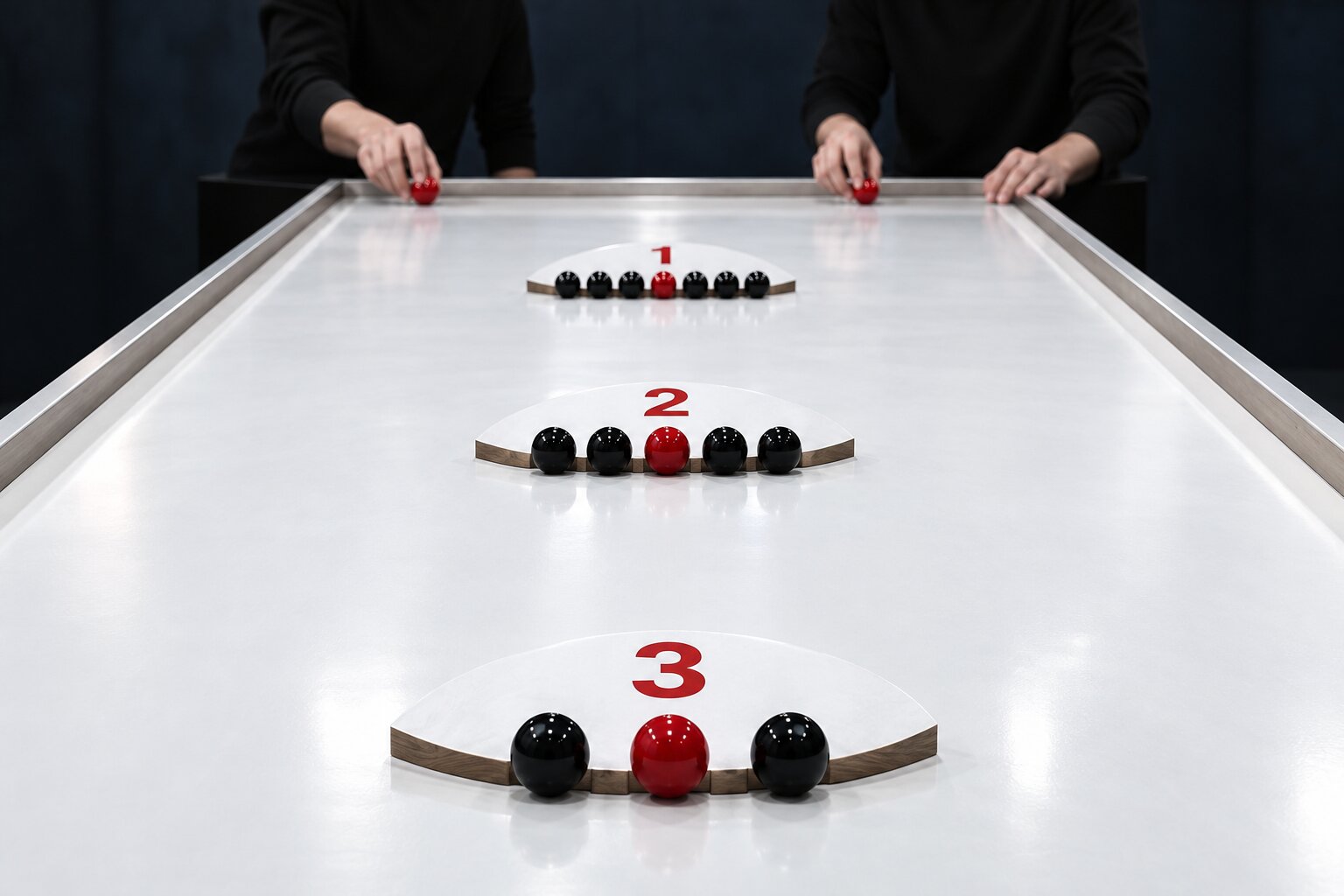

THE GAME EXPLAINED / STAR CLUSTER BALL
Which Star Cluster Ball Rules Apply? Event Checklist
Use this pre-match checklist to confirm timing, turn order, scoring, fouls, equipment and tie-breaks with the event organizer.
QUICK RULES
Five rules to confirm before a match
Ask the organiser to publish these conditions before play begins.
- Schedule
- Who starts, and does the game end by time, balls played or target score? Confirm
- Turn order
- Who plays after a score, a miss or a foul? Confirm
- Scoring
- What are the base values, connected-ball bonus and full-plate bonus? Confirm
- Judgments
- How are edge positions, out-of-bounds balls and invalid releases handled? Confirm
- Winner
- Who verifies the final score, and how are ties resolved? Confirm

01 / THE GAME EXPLAINED
Ask which rules this match uses
Public information about Star Cluster Ball can introduce the table, target plates and common scoring concepts. It cannot referee every event. A beginner session, club social, livestream challenge and formal tournament may differ in timing, first player, bonuses or special cases. The most useful question at the table is: “Which rules apply here, and is there a card I can read?” A short shared explanation before the first shot prevents many disputes later.
This guide is a checklist, not another document claiming to govern the sport. It groups questions into equipment, release, scoring, timing, unusual ball states, fouls, disputes and records. A participant can use it while watching or joining a match; a host can use it to see whether their explanation is complete. A relaxed session may simplify some mechanisms. A formal event should publish the details in advance and give every entrant the same version.
02 / THE GAME EXPLAINED
Step one: identify the equipment
Confirm the actual table, three target plates and valid slots match what players were shown beforehand. A public overview describes a seven-, five- and three-position arrangement, but an event needs more precise answers. What counts as a valid slot? How is a ball on the edge judged? May a plate move? What happens in a rail or gutter area? If equipment from different makers or production batches is mixed, decide before play which variations are allowed.
State the two ball colours and the number of balls per side. Red and black are common in footage but need not be assumed for every event. Replace or identify balls with unclear marks, unequal size or damage before the opening shot. Discovering halfway through that a ball’s owner or legal status is uncertain interrupts play and weakens trust in the score.
03 / THE GAME EXPLAINED
Step two: define release and turn order
A rules card should show the release area, line and body boundary. Where does the ball enter the playing surface? May a player touch a moving ball or deliberately use a rail? What follows a release made beyond the line? A published account mentions the player on the right beginning, but that is one reported format, not a replacement for a draw, rotation or first-player choice made by a local organizer.
Also define whether a score gives another shot, when a miss ends control and what happens when a player runs out of balls. A teaching session might alternate strictly to provide equal practice; another match may use continuation after a valid score. The central requirement is not that one mechanism is inherently more authentic. It is that both sides understand it beforehand and that it is applied consistently. One full demonstration often teaches more than a long list of unexplained terms.
04 / THE GAME EXPLAINED
Step three: make scoring auditable
Separate base points, chains, full-plate results and any other bonuses. First say how a ball qualifies for a valid position. Then list base values for the plates or slots. Explain what adjacency creates a chain, what fills a plate and whether bonuses can be combined. Chinese public summaries differ on some numbers and combination details, so a host should provide at least one shot-by-shot example that explains each change on the scoreboard.
A transparent record can include colour, target, base value, bonus, special state and running total. An electronic system should let an umpire trace a score change rather than merely show a number. If an introductory event does not use advanced bonuses, say “this session uses base points only.” Simplification is helpful; silence about what has been simplified is not.
05 / THE GAME EXPLAINED
Step four: state the end condition
One public description uses two six-minute halves. A different activity might end at a target score, after a fixed ball count or after a shorter teaching period. Specify total time, whether sides change, whether a pause stops the clock, how a ball still moving at the buzzer is judged, and how balls left in hand are treated. State any overtime or sudden-death procedure before a tie occurs.
Time changes tactical choices. In a countdown match, the final minute may reward a very different level of risk from an untimed practice game. Before criticizing a player for avoiding an apparently safer route, a viewer should know how much time remained. A clip without the complete clock or format supports analysis of the visible shot, not certainty about optimal endgame strategy.
06 / THE GAME EXPLAINED
Step five: cover unusual ball states
A ball may settle outside a plate, touch a rail, enter a gutter, be moved by contact, return toward the release end or stop on a boundary. State whether each ball remains, returns to a player, leaves the round or must be replaced. Say who may touch it and when. Moving a ball before a decision makes the position and score difficult to reconstruct.
Contact that sends an opponent’s ball into a target deserves particular clarity. Who receives the points? May the current player continue? Does an earlier bonus remain? A player need not memorize every edge case, but an umpire and scorer should be able to point to the same text. An informal session can adopt a simpler treatment if both sides agree before that situation arises.
07 / THE GAME EXPLAINED
Step six: identify fouls and safety calls
Crossing a line, interfering with an opponent, touching a moving ball, moving the table or deliberately delaying play appear in some public accounts as fouls or improper conduct. The consequence may be a void ball, lost turn, penalty points or another action. Merely writing “foul” does not tell a player what will happen. A formal event should list the behavior, decision-maker, sanction and route for raising a question. A beginner session should explain safety in plain language, such as keeping hands clear while another player releases a ball.
Etiquette also supports play. Give an opponent space, avoid obstructing their view and do not launch the next ball while a dispute is unresolved. Pause first if equipment is damaged or someone feels unwell. Rules should create predictable conditions for enjoying the game, not turn every small mistake into a surprise punishment. Consistent clear guidance is better than a strict but vague oral warning.
08 / THE GAME EXPLAINED
Step seven: make disputes reviewable
An executable format says who sees a close position, whether video may be consulted, when an objection must be raised and how a decision is recorded. If there is no replay, leave the relevant balls untouched while both sides see the resting position. A small social game does not need a tribunal. It still benefits from an agreement to pause and ask the host for one consistent interpretation. Once another ball has been played, the earlier layout may be impossible to recreate.
Record the rule version too. If a host updates a base value or special-ball clause, the event poster, web page and table-side card should carry the same date or version identifier. This site provides concepts and a checklist; it is not an umpiring body for an unidentified match. Where an event makes its rules public, a match page should link to that exact version instead of relying on a broad secondary summary.
09 / THE GAME EXPLAINED
Different goals for different sessions
A beginner experience aims to show the table and build a repeatable release. Rules may be simpler but must remain clear: colours, turns and base scoring can be taught first, with complex bonuses introduced later. A club session may focus on positions and chains, leaving extra time for demonstration and review. A tournament needs fuller text, approved equipment, consistent scoring and a dispute process. One unexplained generic sheet cannot serve all three equally well.
Participants can prepare accordingly. Bring questions to a taster session and concentrate on touch. Ask a club about format and experience level. Before a tournament, read the published document and seek clarification on ambiguous clauses. A sport does not become interesting by making every session complicated. It becomes accessible when the people at each table know which game they are actually playing.
10 / THE GAME EXPLAINED
A checklist to take to the table
Before the opening shot, confirm that equipment matches the description; colours and ball counts; release area, first player and turn changes; valid target positions; base and bonus points; non-scoring and displaced balls; time and end condition; fouls and safety; ties; and who resolves a dispute. If nobody can explain one of these items, add the answer to the local card before play. Each answer need not be long, but both sides must understand it.
For a reader, the checklist is not a reason to distrust every match. It helps identify a format that can be explained and applied. Public articles provide vocabulary, examples and ways to watch. The document published and consistently enforced for the event determines the actual result of a ball. Keeping that boundary intact lets tactical discussion start from the same table and the same facts.
11 / THE GAME EXPLAINED
What a local rules card could look like
Imagine a ten-minute introductory session. A host could divide a card into “before,” “each shot” and “end.” Before play it states colours, release point, first player and timer. The shot section covers valid positions, base score, when control passes, non-scoring balls and fouls. The final section explains the winner and any tie. If advanced rewards are not used, the card explicitly says so. This is an example of clear presentation, not a proposal that every match last ten minutes or remove bonuses.
Each line is stronger when paired with a physical demonstration. Point to the release line, place a practice ball outside a target and show how the display updates. If two interpretations remain possible, edit the wording before the first contested push instead of expecting an umpire to improvise during a dispute. Repeated beginner questions after the event can reveal where the next version needs a diagram or worked example.
12 / THE GAME EXPLAINED
Why two recordings may seem to use different rules
The explanation can be ordinary: a different equipment version, a taster rather than a tournament, a clip missing earlier shots, or a scoreboard showing a bonus without explaining it. A secondary commentator may even mix in a similarly named game. Look for the publisher, event, recording date and format before drawing conclusions. Where that context is absent, separate what the balls visibly did from what you infer about the score. Two different scores do not automatically prove that either player or organizer acted improperly.
For a club operator, publishing a rule version helps spectators as much as umpires. Attach a short card to a livestream, identify the clause behind an unusual decision and retain a score record afterward. New viewers are more likely to follow a match when its story can be explained. A website guide can supply a framework, but the most valuable source is an accurate rule document maintained by the event using it.
SOURCES & MORE
Independent rules overview ↗This is an introduction. For competitions and events, follow the organiser’s published rules and equipment specifications.